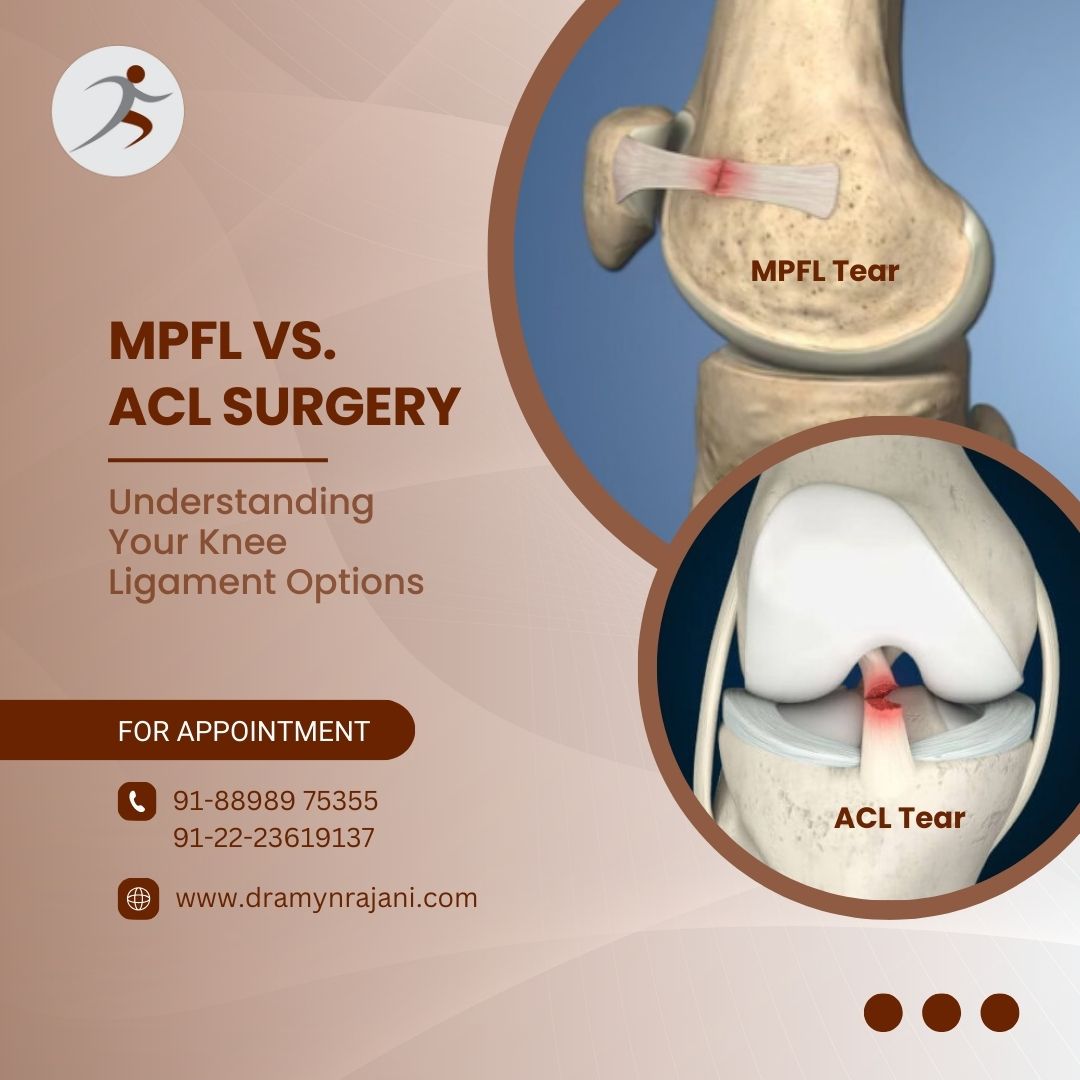
MPFL surgery and ACL surgery both address knee instability, but they treat different structures and different types of knee problems. The Medial Patellofemoral Ligament (MPFL) helps stabilise the kneecap, while the Anterior Cruciate Ligament (ACL) helps control forward and rotational movement of the knee.
ACL injuries are particularly common in sports involving sudden stops, changes in direction and awkward landings. ACL injuries are also a significant knee problem in India, with research reporting an incidence of around 68.6 ACL tears per 100,000 people each year. MPFL injuries, on the other hand, are more closely associated with patellar instability, including repeated kneecap dislocation or subluxation.
If you have a knee injury involving the kneecap or a ligament, the symptoms and type of instability can help guide the initial evaluation. However, the final diagnosis requires a clinical examination and appropriate imaging.
What Is the MPFL?
The medial patellofemoral ligament, commonly called the MPFL, is an important stabilising structure on the inner side of the knee. It helps prevent the kneecap from moving too far towards the outside of the knee.
The MPFL contributes around 50% to 60% of the medial restraining force during the early part of knee movement, particularly between 0 and 30 degrees of knee flexion. As the knee bends further, the shape of the trochlear groove provides greater stability to the kneecap.
When the MPFL is damaged, patients may experience repeated kneecap dislocation, a slipping sensation or instability while moving the knee.
What Is the ACL?
The Anterior Cruciate Ligament, or ACL, is located inside the knee joint. It helps prevent excessive forward movement of the tibia and contributes to rotational stability.
ACL injuries commonly occur during sudden changes in direction, deceleration, jumping or landing. A torn ACL can cause pain, swelling and a feeling that the knee is giving way.
The ACL can also be injured along with other knee structures. Meniscus and cartilage injuries may occur at the same time, which can affect the treatment plan.
What Is MPFL Surgery?
MPFL reconstruction is performed to restore stability to the kneecap when the ligament has been damaged. It is generally considered for patients with recurrent lateral patellar dislocation or subluxation, particularly when conservative treatment has not provided adequate stability.
What Is Checked Before MPFL Surgery?
Before MPFL surgery, the surgeon evaluates the knee's alignment and structure. Important factors include:
- TT-TG distance: This helps assess the alignment between the tibial tubercle and trochlear groove. A significantly increased distance may require an additional procedure.
- Trochlear dysplasia: An abnormal or shallow trochlear groove can affect kneecap stability.
- Patella alta: This refers to a kneecap positioned higher than usual and can increase the risk of recurrent dislocation.
MRI and CT imaging may therefore be used to assess knee structure and alignment before surgery.
Graft Options for MPFL Reconstruction
Common graft options include the gracilis or semitendinosus tendons, a portion of the quadriceps tendon or a soft-tissue allograft. Modern fixation methods include suture anchors, short blind tunnels and quadriceps tendon-based techniques.
Graft tension is also important during reconstruction. Excessive tension can increase pressure within the patellofemoral joint and affect knee movement.
MPFL Repair vs Reconstruction
MPFL repair and reconstruction are different procedures, such as:
- MPFL repair reconnects the patient's existing ligament and may be considered after a first-time dislocation when the ligament has pulled away from the bone, but the tissue remains suitable for repair.
- MPFL reconstruction replaces the damaged ligament using a graft. It is more commonly considered for recurrent instability, chronic ligament laxity or significant ligament damage.
What Is ACL Reconstruction Surgery?
ACL reconstruction replaces a damaged ACL with a graft to restore knee stability. It may be considered when a patient has ongoing anterior or rotational instability, particularly when they want to return to activities involving pivoting or rapid changes in direction.
Diagnosis usually involves a clinical examination, including tests such as the Lachman, anterior drawer and pivot-shift tests, along with MRI imaging. The surgeon may also assess associated meniscus or cartilage injuries.
ACL Graft Options
The graft selected for ACL reconstruction depends on factors such as the patient's age, activity level, sport and individual knee condition.
Common options include:
- Bone-patellar tendon-bone graft: Provides strong fixation but can be associated with anterior knee pain and kneeling discomfort.
- Hamstring tendon graft: Uses the gracilis and semitendinosus tendons and generally has lower donor-site morbidity.
- Quadriceps tendon graft: Provides a large graft and may be used in selected primary or revision cases.
- Allograft: Uses donor tissue and avoids harvesting tissue from the patient.
How Is the ACL Graft Fixed?
During ACL reconstruction, tunnels are created in the tibia and femur so that the graft can be positioned close to the natural ACL attachment points. Fixation devices such as interference screws or cortical buttons hold the graft in place while it heals.
ACL reconstruction is commonly performed arthroscopically, allowing the surgeon to examine the joint and treat associated meniscus or cartilage injuries when needed.
MPFL Surgery vs ACL Surgery: Key Differences
Although both procedures improve knee stability, they treat different ligaments and address different types of instability.
| Clinical Factor | MPFL Reconstruction | ACL Reconstruction |
| Ligament treated | Medial Patellofemoral Complex | Anterior Cruciate Ligament |
| Main problem | Kneecap dislocation or subluxation | Anterior or rotational knee instability |
| Common indication | Recurrent patellar instability | ACL tear with functional instability |
| Key assessment | TT-TG distance, trochlear shape and patellar height | Lachman test, pivot-shift and MRI |
| Common grafts | Gracilis, semitendinosus, quadriceps tendon or allograft | BPTB, hamstring, quadriceps tendon or allograft |
| Main surgical concern | Excessive graft tension and patellar instability | Graft positioning, tunnel placement and rotational stability |
| Return to sport | Around 6 to 9 months | Around 6.5 to 10 months depending on graft and recovery |
These differences are based on the clinical and surgical comparison outlined in the source material.
Recovery After MPFL Surgery
MPFL rehabilitation focuses on restoring knee movement, activating the quadriceps and gradually improving stability.
Full range of motion is generally targeted within 4 to 6 weeks. Low-impact activities may resume around 3 to 4 months, while returning to pivoting or contact sports may take around 6 to 9 months, depending on strength, stability, and clinical assessment.
The recovery period can vary if additional procedures are performed alongside MPFL reconstruction.
ACL Surgery Recovery Time
ACL recovery follows a gradual rehabilitation programme. The early phase focuses on controlling swelling, restoring knee extension and improving quadriceps activation.
Rehabilitation then progresses to strengthening, balance exercises, jogging, and sport-specific activities. Return to high-impact sport generally takes several months, with the source material giving a range of approximately 6.5 to 10 months depending on the graft used.
Rehabilitation is also an important part of recovery after an injury or surgery. The WHO describes rehabilitation as an essential health service that can help people regain function and reduce the impact of injury and other health conditions.
ACL Surgery Cost in India
The cost of ACL reconstruction surgery in India generally ranges from ₹80,000 to ₹2,50,000 in private orthopaedic centres. The final cost depends on the hospital, city, graft type and whether additional procedures for meniscus or cartilage damage are required.
In major cities such as Mumbai, Delhi and Bengaluru, standard ACL reconstruction packages using a hamstring autograft are reported at around ₹1,20,000 to ₹2,00,000, including the operating theatre, surgeon fees, graft and hospital stay.
Is MPFL Surgery Worse Than ACL Surgery?
MPFL surgery and ACL surgery cannot be compared simply as better or worse because they treat different problems.
ACL reconstruction involves work inside the knee joint, including precise tunnel placement and graft fixation. Its rehabilitation can also take several months before a patient is ready for high-demand sports.
MPFL reconstruction has a different set of technical considerations. Correct graft positioning and tension matter, and some patients may also need treatment for underlying alignment or structural problems such as increased TT-TG distance or trochlear dysplasia.
The appropriate procedure depends on the injured structure, the type of instability and the patient's individual knee condition.
Which Procedure May You Need?
Symptoms and injury mechanism can provide an initial indication, while clinical assessment and imaging help confirm the condition.
- MPFL evaluation: Considered when the kneecap repeatedly moves out of position or feels unstable. MRI and CT may help assess patellar alignment and the trochlear groove.
- ACL evaluation: Considered when the knee repeatedly gives way during pivoting, cutting, or sudden direction changes after an injury. Clinical tests and MRI help assess the ACL and identify associated meniscus or cartilage damage.
Looking for MPFL or ACL Surgery in Mumbai?
If you are experiencing recurrent knee instability, patellar dislocation, or an ACL injury, a proper orthopaedic evaluation can help identify the affected ligament and guide the right treatment approach.
Dr. Amyn Rajani, Consultant Knee, Shoulder and Hip Surgeon and Chief Surgeon and Director of OAKS Clinic in Mumbai, specialises in knee arthroscopy, ACL reconstruction and reconstructive knee procedures. With more than 20 years of experience in arthroscopy and joint replacement, his practice covers conditions including ACL tears, knee ligament injuries and patellofemoral problems. The evaluation may include a clinical examination and MRI to understand the extent of the injury and plan suitable treatment and rehabilitation.
Conclusion
MPFL reconstruction and ACL reconstruction are different knee procedures designed to address different types of instability. MPFL surgery focuses on stabilising the kneecap, while ACL reconstruction restores stability during forward and rotational movements.
The right treatment depends on the injured ligament, knee anatomy, symptoms, activity level and associated injuries. A detailed evaluation by an orthopaedic knee specialist can help determine whether surgery is required and which approach may be appropriate.
Frequently Asked Questions
What is MPFL surgery used for?
MPFL reconstruction mainly restores stability when the kneecap repeatedly dislocates or subluxes. The procedure reconstructs the ligament that helps prevent excessive outward movement of the kneecap.
What is ACL reconstruction surgery?
ACL reconstruction replaces a torn ACL with a graft to restore stability against forward and rotational movement of the knee.
How long does ACL surgery recovery take?
Recovery can take around 6 to 10 months before clearance for high-impact sports, depending on factors such as graft selection, rehabilitation and functional recovery.
What is the cost of ACL surgery in India?
ACL reconstruction generally costs around ₹80,000 to ₹2,50,000 in India's private sector. Major-city packages for standard hamstring autograft reconstruction may range from ₹1,20,000 to ₹2,00,000.
Is MPFL surgery worse than ACL surgery?
Neither procedure is universally worse. They treat different types of knee instability, and each procedure's complexity depends on the patient's injury and knee anatomy.
What is the difference between MPFL repair and reconstruction?
MPFL repair reconnects the patient's existing ligament and may be considered for selected first-time injuries. Reconstruction replaces the damaged ligament with a graft and is generally considered for recurrent instability or significant ligament damage.
Meet Dr. Amyn Rajani - Your Trusted Knee Specialist in Mumbai
When it comes to knee ligament injuries, choosing the right surgeon is crucial. Dr. Amyn Rajani is a renowned orthopaedic doctor in Mumbai with extensive experience in ACL reconstruction surgery and MPFL reconstruction. Known for his patient-centric approach and expertise in minimally invasive techniques, Dr. Rajani has helped countless patients regain their mobility and return to an active lifestyle.
Whether you’re an athlete recovering from an ACL tear or someone dealing with recurrent patellar dislocations, Dr. Rajani provides personalized care tailored to your needs. His clinic is equipped with advanced technology, ensuring the highest standards of treatment. If you’re looking for a knee specialist in Mumbai, Dr. Amyn Rajani is a name you can trust.