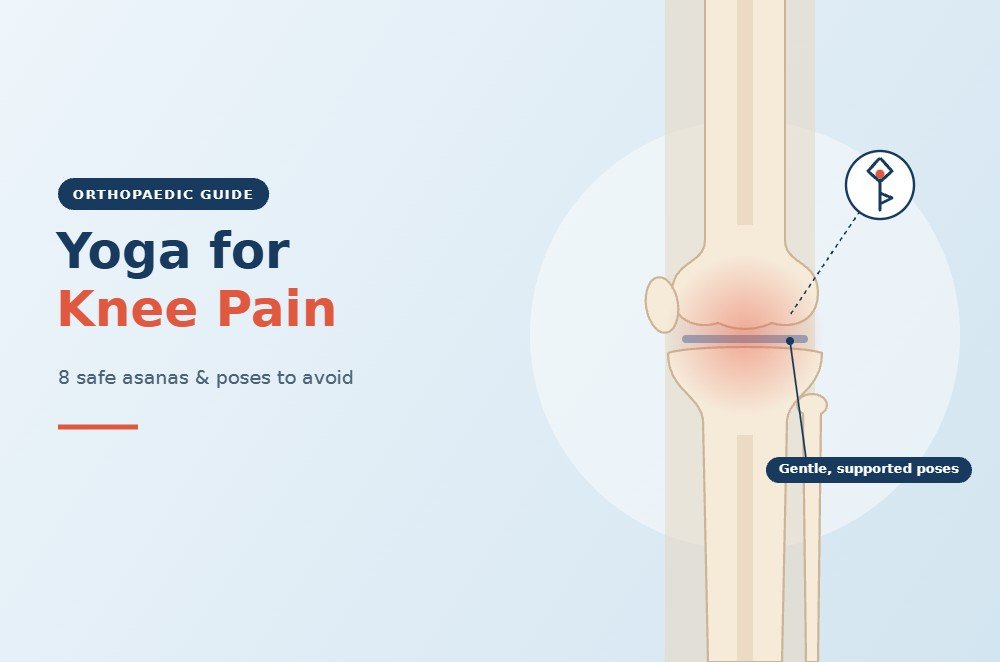
Knee pain can make everyday activities such as walking, climbing stairs, and sitting down uncomfortable. If you enjoy yoga, you may wonder whether continuing your practice will help or put more pressure on your knees.
The answer depends on the cause of your pain, the poses you choose, and how you perform them. Gentle, modified yoga can help improve flexibility, balance, and muscle strength. However, poses that involve deep knee bending, twisting, or putting too much weight on the joint may increase discomfort.
Yoga can be particularly useful as part of a wider exercise plan for people with knee osteoarthritis. A 2025 randomised clinical trial published in JAMA Network Open compared a structured yoga programme with strengthening exercises in 117 adults. Both groups improved knee pain over 12 weeks. Yoga was non-inferior to strengthening exercises, with some additional improvements in pain, stiffness, and physical function reported at 24 weeks.
This guide covers eight yoga asanas for knee pain, poses you may need to avoid or modify, and practical precautions to help you exercise safely.
How Does Yoga Help With Knee Pain?
Yoga combines controlled movement, stretching, balance, and breathing exercises. When adapted to your physical condition, it can support the muscles and movements that help your knees function comfortably.
Here are some ways a suitable yoga routine may help:
- Modified poses can engage the quadriceps, hamstrings, and hip muscles. These muscles help support the knee during walking, standing, and other daily activities.
- Gentle stretching can reduce tightness in the muscles around the thighs and hips, making some movements more comfortable.
- Standing poses can improve balance and body awareness. This may help you maintain better control while moving.
- Slow movements help you become more aware of knee alignment and avoid sudden or poorly controlled movements.
- When included in an appropriate exercise programme, yoga may help manage symptoms such as pain and stiffness.
The benefits depend on the condition of your knee. For example, knee osteoarthritis, ligament injuries, and kneecap-related problems may require different exercises. Understanding the possible reasons behind persistent knee pain is an important first step before starting a new routine.
8 Yoga Asanas for Knee Pain
Consider the following poses for a gentle yoga routine. Their suitability depends on your symptoms, mobility, and diagnosis. Start with a comfortable range of movement, use support where needed, and avoid forcing your knees into a position.
1. Tadasana (Mountain Pose)
Tadasana is a standing pose that helps improve posture and awareness of leg alignment. It is a simple starting point for people who want to practise controlled standing movements.
How to perform it:
- Stand with your feet hip-width apart.
- Distribute your body weight evenly across both feet.
- Keep your knees relaxed rather than locking them.
- Lengthen your spine and keep your shoulders relaxed.
- Hold the position while breathing normally.
How it helps: It encourages balanced weight distribution and helps you become more aware of your standing posture. Hold a wall or chair if you feel unsteady.
2. Setu Bandhasana (Bridge Pose)
Perform Bridge Pose while lying on your back. It engages the gluteal muscles and hamstrings, which support hip and leg movement.
How to perform it:
- Lie on your back with your knees bent.
- Keep your feet flat on the floor and hip-width apart.
- Place your arms beside your body.
- Slowly lift your hips while keeping your feet stable.
- Gently lower your hips and return to the starting position.
How it helps: The pose works the gluteal and hamstring muscles. These muscles contribute to lower-limb stability and movement. Avoid lifting your hips too high if the position causes knee discomfort.
3. Virabhadrasana I (Modified Warrior One)
A modified Warrior One can help engage the thigh and hip muscles. However, a deep lunge may increase pressure around the knee, so keep the movement shallow.
How to perform it:
- Stand with your feet apart and take a comfortable step forward.
- Keep your back foot stable.
- Bend the front knee slightly, only as far as comfortable.
- Keep the knee aligned with the direction of your foot.
- Use a wall or chair for balance if required.
How it helps: This modified position engages the muscles around the hips and thighs. Avoid deep lunging and stop if you feel pain around the kneecap or inside the knee.
4. Supta Padangusthasana (Reclining Hand to Big Toe Pose)
This reclining pose stretches the back of the leg without requiring you to stand or place your body weight on the knee.
How to perform it:
- Lie flat on your back.
- Keep one leg extended on the floor.
- Slowly raise the other leg while keeping the knee comfortably straight.
- Use a yoga strap or towel around your foot for support.
- Raise the leg only until you feel a gentle stretch.
- Lower it slowly and repeat on the other side.
How it helps: It gently stretches the hamstrings and supports flexibility in the back of the thigh. Do not pull the leg towards your chest forcefully.
5. Utkatasana (Supported Chair Pose)
A shallow Chair Pose can engage the quadriceps, which play an important role in supporting knee movement. Since this pose involves bending the knees, use a wall or chair for assistance.
How to perform it:
- Stand with your back against a wall or hold a stable chair.
- Keep your feet hip-width apart.
- Slowly bend your knees a little, as if preparing to sit.
- Keep your knees aligned with your feet.
- Return to the standing position without rushing.
How it helps: It activates the quadriceps and gluteal muscles. Avoid deep squats, and stop if you feel pain or pressure around the kneecap.
6. Makarasana (Crocodile Pose)
Makarasana is a relaxation pose performed while lying on your stomach. It can be included in a gentle yoga routine as a resting position between movements.
How to perform it:
- Lie on your stomach on a comfortable mat.
- Place your hands under your forehead or fold your arms.
- Keep your body relaxed.
- Breathe slowly and comfortably.
- Remain in the position for a short period.
How it helps: It provides a resting position between exercises and encourages relaxation. It does not directly strengthen the knee or treat the underlying cause of knee pain.
7. Viparita Karani (Legs Up the Wall Pose)
This restorative pose involves lying on your back with your legs supported by a wall. It does not require weight-bearing through the knees.
How to perform it:
- Sit sideways next to a wall.
- Slowly turn onto your back and bring your legs up against the wall.
- Keep your legs relaxed.
- Adjust your distance from the wall so the position feels comfortable.
- Rest for a few minutes and return to sitting slowly.
How it helps: It offers a supported resting position without placing body weight on the knee joint. If your knees feel stretched or uncomfortable, bend them slightly or skip the pose.
8. Dandasana (Staff Pose)
Dandasana is a seated pose that encourages an upright posture and gentle engagement of the thigh muscles.
How to perform it:
- Sit on the floor with your legs extended in front.
- Place your hands beside your hips for support.
- Keep your back straight without forcing it.
- Gently engage your thigh muscles.
- Keep your knees in a comfortable position.
How it helps: It encourages an upright sitting posture and awareness of the thigh muscles. If your hamstrings feel tight or your lower back rounds, sit on a folded blanket or cushion.
Important: These poses are not a replacement for an individual exercise prescription. If you have significant knee pain, swelling, a recent injury, or difficulty bearing weight, get medical advice before starting yoga.
What Does Research Say About Yoga for Knee Osteoarthritis?
The 2025 study, Yoga or Strengthening Exercise for Knee Osteoarthritis: A Randomized Clinical Trial, was published in JAMA Network Open on 8 April 2025.
Researchers randomly assigned 117 adults with knee osteoarthritis to either a yoga programme or a strengthening exercise programme. Both groups followed supervised sessions and home-based exercise routines.
The findings included:
- Both groups reported improvements in knee pain over 12 weeks.
- Yoga was non-inferior to strengthening exercise for reducing knee pain over this period.
- At 24 weeks, the yoga group showed greater improvements in certain secondary measures, including knee pain, stiffness, and physical function.
- Adverse events were similar in both groups and were generally mild.
These findings suggest that a structured yoga programme can be a useful exercise option for some people with knee osteoarthritis. However, the study does not establish that every yoga pose is safe for every knee condition. The programme was specifically designed for people with osteoarthritis, so its results should not be applied to all types of knee pain.
Research reference: Read the full 2025 clinical trial in JAMA Network Open.
Yoga Poses to Avoid or Modify With Knee Pain
Some yoga poses place the knee in deep flexion or require rotation while the joint is bent. These positions may aggravate symptoms in people with arthritis, meniscus injuries, or other knee conditions.
The following poses may need to be avoided or modified:
| Yoga pose | Why it may cause discomfort |
|---|---|
| Vajrasana (Thunderbolt Pose) | Deep knee bending can increase pressure around the kneecap and may be uncomfortable for people with limited knee mobility. |
| Padmasana (Lotus Pose) | The position requires considerable hip rotation. If the hips are tight, the movement may place unwanted twisting stress on the knees. |
| Virasana (Hero Pose) | The pose involves deep knee flexion and may aggravate pain in people who cannot comfortably bend their knees. |
| Malasana (Garland Pose) | A deep squat places considerable load on the knee joint, particularly when held for a long time. |
| Balasana (Child’s Pose) | Deep knee bending may be uncomfortable. A cushion between the thighs and calves may help, but the pose should be skipped if pain continues. |
You do not necessarily need to avoid every pose permanently. A modified version may suit some people, depending on their condition and mobility. However, do not force a position simply because it is part of a traditional yoga routine.
If you experience sharp pain, painful clicking, locking, or increased swelling during or after a pose, stop the activity. Persistent swelling can have several causes, including inflammation of the joint lining. You can read more about synovitis and inflammation inside the knee joint if this diagnosis has been raised during your assessment.
How to Practise Yoga Safely With Knee Pain
A few precautions can make your yoga practice more comfortable and reduce the risk of aggravating an existing knee problem.
- Warm up before starting: Begin with gentle movements rather than moving directly into stretches or standing poses.
- Stay within a comfortable range: Do not force deep bends, lunges, or stretches.
- Maintain knee alignment: In standing poses, keep the knee aligned with the direction of your foot.
- Use support: Yoga blocks, straps, cushions, and stable chairs can help you modify certain positions.
- Avoid sudden movements: Move slowly when changing positions, especially when getting up from the floor.
- Choose an experienced instructor: Tell your yoga teacher about your knee condition so they can modify poses.
- Monitor your symptoms: Stop if pain increases, swelling develops, or your knee feels unstable.
Yoga can be one part of a broader knee recovery plan. Depending on your diagnosis, a specialist may recommend strengthening exercises, mobility work, and a structured knee physiotherapy programme. The exercises should match your symptoms and the condition affecting your joint.
When Should You See a Doctor Before Starting Yoga?
Not all knee pain comes from muscle tightness or reduced flexibility. It may also result from cartilage damage, ligament injuries, arthritis, or kneecap problems.
You should seek medical assessment before starting yoga if you experience:
- Sudden or significant knee swelling.
- Severe pain while standing or walking.
- A knee that locks or gets stuck during movement.
- A feeling that the knee may give way.
- Pain following a fall, sports injury, or sudden twisting movement.
- Difficulty fully bending or straightening the knee.
For example, a meniscus injury can cause pain, swelling, and difficulty moving the knee. You can learn more about meniscus tears and their treatment options.
A clinical examination helps identify the likely cause of your symptoms. Depending on the findings, your doctor may recommend an X-ray, MRI, or other investigations. The diagnosis helps determine whether yoga is appropriate and which movements to modify.
Managing Knee Pain With the Right Treatment Plan
Yoga may help improve movement and manage symptoms, but it cannot repair a torn ligament or reverse cartilage loss caused by advanced osteoarthritis. The right treatment depends on the underlying condition, symptom severity, and your activity needs.
Many people with knee pain can begin with non-surgical treatment. This may include activity modification, physiotherapy, suitable strengthening exercises, and medication when prescribed. Some patients with knee osteoarthritis may also be considered for other treatments, such as viscosupplementation for knee osteoarthritis.
If symptoms remain severe despite appropriate non-surgical care, a specialist may discuss surgical options. These decisions should follow a proper assessment rather than relying on an X-ray or pain level alone.
Conclusion
Yoga can help maintain flexibility, improve balance, and support the muscles around your knees. However, the benefits depend on choosing movements that suit your condition. Gentle poses may help people with knee osteoarthritis and general stiffness, while deep squats, kneeling positions, and twisting movements may aggravate certain knee problems.
The most important step is to understand why your knee hurts before choosing an exercise routine. Do not treat pain as a normal part of yoga practice or force your knees into uncomfortable positions. A suitable combination of medical guidance, physiotherapy, and modified yoga can help you stay active while protecting your knee health.
If you have persistent knee pain or aren’t sure which yoga poses suit your condition, consult Dr. Amyn Rajani, Orthopaedic and Knee Surgeon in Mumbai. You can book an online consultation to discuss your symptoms, understand your diagnosis, and get guidance on suitable treatment and exercise options.
Frequently Asked Questions
Is yoga good for knee pain?
Yoga may help some people with knee pain by improving flexibility, balance, and muscle function. Research also suggests that a structured yoga programme can be a useful exercise option for people with knee osteoarthritis. However, the right poses depend on the cause and severity of the pain.
Which yoga asanas are best for knee pain?
Modified poses such as Tadasana, Bridge Pose, supported Warrior One, Reclining Hand to Big Toe Pose, and supported Chair Pose may be suitable for some people. Start gently and use support. A pose that feels comfortable for one person may not be appropriate for someone with a different knee condition.
Which yoga poses should I avoid with knee pain?
Deep kneeling poses, Lotus Pose, Hero Pose, and deep squats may aggravate knee symptoms, particularly if you have arthritis or limited knee movement. Child’s Pose may also need modification. Avoid any pose that causes pain or discomfort.
Can yoga cure knee osteoarthritis?
No. Yoga cannot reverse cartilage damage or cure knee osteoarthritis. However, a suitable yoga programme may help manage pain, stiffness, and movement difficulties. It works best as part of a broader treatment plan.
Can I do yoga if I have a meniscus tear?
It depends on the type of tear, your symptoms, and your stage of treatment. Deep squats, twisting movements, and positions involving deep knee bending may aggravate symptoms. Consult your orthopaedic specialist or physiotherapist before continuing your yoga practice.
Is walking or yoga better for knee pain?
Both may be useful, but they serve different purposes. Walking is a weight-bearing activity that supports general fitness, while yoga combines movement, flexibility, balance, and controlled muscle engagement. Your doctor or physiotherapist can help you choose an appropriate combination based on your knee condition.
Should I do yoga if my knee is swollen or locking?
Avoid starting or continuing knee-loading yoga poses until a professional has assessed the cause. Swelling and locking can indicate an underlying joint problem that needs medical attention. Seek an orthopaedic evaluation before returning to exercise.
Research Reference
Abafita BJ, et al. Yoga or Strengthening Exercise for Knee Osteoarthritis: A Randomized Clinical Trial. JAMA Network Open. 2025;8(4). Read the full study.