Few knee problems are as concerning as suddenly being unable to move your knee. You may be walking, squatting, or standing up when your knee suddenly gets stuck and becomes difficult to bend or straighten. This condition is known as a locked knee. It can cause sharp pain and make walking difficult.
As an orthopaedic surgeon, I often explain to patients that knee locking can have different causes. Understanding what is happening inside the joint is important for choosing the right treatment. This guide covers the causes, symptoms, diagnosis, and treatment options for a locked knee, along with what you should and should not do.
True Locking vs Pseudo-Locking: Why Is My Knee Locking?
When patients ask why their knee gets stuck, I first explain the difference between true mechanical locking and pseudo-locking. Although both can feel similar, their causes and treatments are different.
| Type | What Is Happening | Typical Behaviour |
|---|---|---|
| True (Mechanical) Locking | A physical obstruction, such as a torn piece of meniscus, blocks joint movement. | The knee cannot fully bend or straighten because something is physically obstructing it. |
| Pseudo-Locking | Pain, inflammation, or muscle spasm temporarily restricts movement. | Movement becomes difficult because of pain and may improve as symptoms settle. |
True mechanical locking usually indicates that a structure inside the joint is obstructing movement. Pseudo-locking is often associated with conditions such as arthritis or kneecap problems. A proper clinical examination helps distinguish between the two and guide further investigations.
Causes of a Locked Knee
A true locked knee usually has a mechanical cause. This means a structure inside the joint physically interferes with normal movement. Some common causes include:
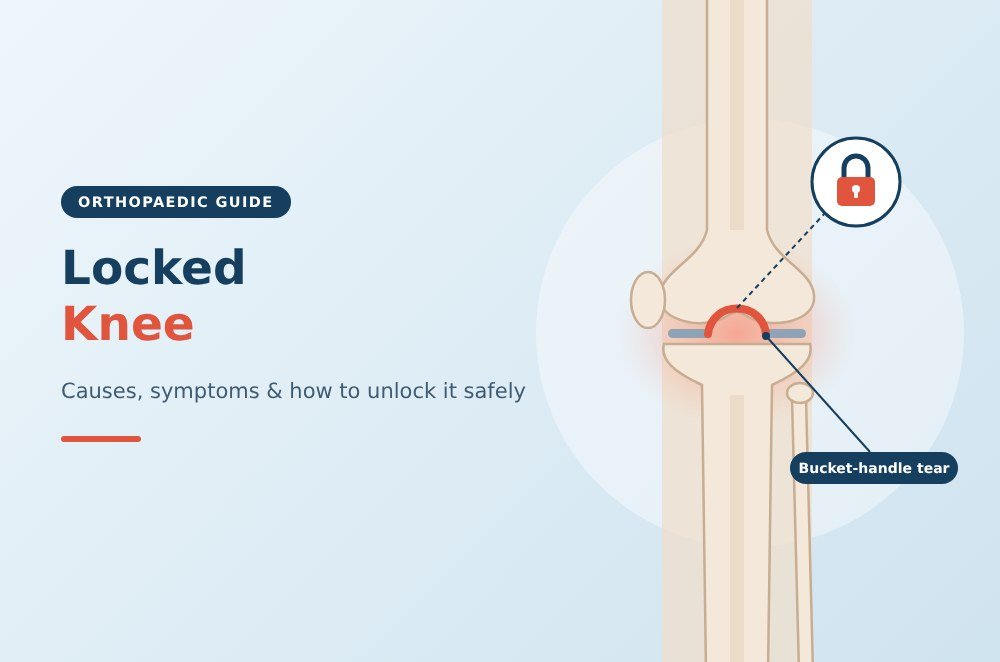
- Bucket-handle meniscus tear: This is one of the common causes of true mechanical locking. A large portion of the torn meniscus folds into the centre of the joint and blocks movement. It often occurs during twisting activities or sports. Depending on the tear, treatment may involve arthroscopic meniscus tear surgery and meniscectomy.
- Loose body in the joint: A small piece of bone or cartilage may break away and move freely inside the knee. If it becomes trapped between the joint surfaces, it can cause sudden locking. Previous injuries and arthritis can contribute to loose body formation. Read more about knee arthroscopy for loose body removal.
- Torn ligament stump: Occasionally, part of a torn anterior cruciate ligament can become trapped inside the joint and restrict movement. This is one reason a suspected ACL tear requires proper assessment.
- Kneecap dislocation: When the kneecap moves out of its normal groove, the knee may become temporarily locked in a bent position. Recurrent dislocation can involve damage to the ligament responsible for kneecap stability, which may require MPFL tear treatment and reconstruction.
- Advanced osteoarthritis: Bone spurs and loose cartilage fragments associated with severe arthritis can sometimes obstruct joint movement and cause locking or catching.
A sudden locked knee after a twisting injury, especially with swelling within a few hours, needs prompt orthopaedic assessment. A bucket-handle meniscus tear may require early treatment to improve the chances of preserving the damaged tissue.
Knee Locking Symptoms to Watch For
A locked knee can cause several symptoms depending on the underlying problem. Common signs include:
- Sudden difficulty or inability to fully bend or straighten the knee.
- Sharp pain when the knee locks, sometimes with a popping sensation.
- Swelling that develops within a few hours after an injury.
- Clicking, catching, or clunking sensations during knee movement.
- A feeling that the knee is unstable or may give way.
- Repeated episodes of the knee getting stuck while bending or straightening.
If your knee repeatedly gets stuck, don’t ignore it. Repeated mechanical obstruction may affect the surrounding cartilage. A knee specialist in Mumbai can assess the issue, identify the cause, and recommend the right treatment.
How to Unlock a Locked Knee Safely
If your knee suddenly locks, your immediate response is important. The goal is to protect the joint and avoid making the problem worse.
What to Do
- Stop and rest: Sit or lie down and avoid putting weight on the affected knee.
- Relax your muscles: Keep the leg relaxed and avoid sudden movements.
- Avoid forcing movement: If the knee moves comfortably, you may be able to move it gently. Stop immediately if you experience pain or resistance.
- Apply ice and elevate: Use an ice pack wrapped in a towel for short periods and keep the leg elevated to help manage swelling.
- Get medical assessment: Even if the knee unlocks, arrange an examination to identify the underlying cause. A knee and orthopaedic surgeon in Mumbai can assess the joint and recommend suitable investigations.
What to Avoid
- Do not force the knee: Avoid pushing, pulling, or twisting the joint to unlock it.
- Do not continue walking: Avoid putting unnecessary pressure on a mechanically locked knee.
- Do not ignore repeated episodes: Recurrent locking needs medical assessment to prevent further joint problems.
Seek urgent medical attention if you notice a visible deformity, cannot bear weight, experience numbness or tingling in your foot, or have severe and persistent pain.
How a Locked Knee Is Diagnosed
The first step in treatment is identifying what is physically blocking the joint or causing restricted movement. I begin by understanding how the locking started, whether there was an injury, and which movements trigger the symptoms.
The following investigations may be recommended:
| Investigation | What It Shows |
|---|---|
| X-ray | Identifies fractures, bony loose bodies, and arthritis-related changes. |
| MRI scan | Provides detailed images of meniscus tears, ligament injuries, and loose cartilage fragments. |
| CT scan | Gives a detailed view of bone fragments when required. |
An MRI is particularly useful when a meniscus tear or ligament injury is suspected. It also helps assess other structures inside the knee. Our guide to common causes of knee pain in adults explains why identifying the exact source of pain is important.
Locked Knee Treatment
Treatment depends on the underlying cause. Some patients improve with non-surgical care, while true mechanical locking may require arthroscopic surgery.
- Pseudo-locking: When pain, inflammation, or muscle spasm restricts movement without a physical obstruction, treatment focuses on the underlying condition, pain management, and gentle movement.
- Bucket-handle meniscus tear: A displaced tear causing true mechanical locking often requires keyhole surgery, known as arthroscopy. The surgeon may repair the torn meniscus or remove only the damaged portion when repair is not suitable. Preserving the meniscus wherever possible helps protect the knee cartilage over time.
- Loose body: Surgeons can remove a loose bone or cartilage fragment through arthroscopic surgery to restore normal joint movement.
- Torn ligament stump: The trapped tissue may be removed arthroscopically. If the ligament also causes instability, we may recommend reconstruction.
- Kneecap dislocation: The kneecap is repositioned, followed by appropriate bracing and physiotherapy. Recurrent dislocations may require surgery to improve stability. Our comparison of MPFL and ACL surgery options explains how these ligament procedures differ.
After surgery, rehabilitation helps restore movement, strength, and joint stability. A guided physical therapy programme for the knee can support recovery, while a structured knee rehabilitation programme helps patients progress towards their regular activities. As recovery progresses, you can also introduce specific knee rehabilitation exercises.
Why is meniscus preservation important?
The meniscus acts as a cushion between the thigh bone and shin bone. It helps distribute pressure and protects the joint cartilage. Whenever the tear pattern and tissue condition allow, repairing the meniscus is generally preferred over removing a larger portion. Early assessment can help determine whether repair is possible.
Bottom Line
Do not treat a locked knee as a minor movement problem, especially if it occurs suddenly or keeps returning. The cause may be a meniscus tear, loose body, ligament injury, or another condition affecting the joint.
I am Dr. Amyn Rajani, an orthopaedic and knee surgeon with more than 20 years of experience and an MS in Orthopaedics from the University of Mumbai, where I graduated as a gold medallist. My work in arthroscopic knee surgery also includes academic research. You can find Dr Amyn’s orthopaedic research and publications on Google Scholar.
If your knee is getting stuck, painful, or difficult to straighten, an early assessment can help identify the problem and prevent further damage. You can book a consultation with Dr. Amyn Rajani to discuss your symptoms and treatment options.
Frequently Asked Questions
Why does my knee lock when bending?
A knee that locks while bending may have a physical obstruction inside the joint. Common causes include a displaced meniscus tear or a loose bone or cartilage fragment. Pain and muscle spasms can also restrict movement without a physical obstruction. An examination and MRI scan can help identify the cause.
Is a locked knee an emergency?
A locked knee needs prompt medical assessment. Seek emergency care if you notice a visible deformity, cannot bear weight, experience numbness or tingling in the lower leg, or have severe and persistent pain. A knee that remains locked or repeatedly gets stuck should also be assessed promptly.
Can a locked knee unlock on its own?
Pseudo-locking caused by pain or muscle spasm may improve with rest and appropriate treatment. True mechanical locking may sometimes resolve temporarily, but the underlying obstruction can remain and cause further episodes.
How do you fix a locked knee?
Treatment depends on the cause. A displaced meniscus tear may require arthroscopic repair or removal of the damaged portion. Doctors can remove loose bodies through keyhole surgery, while they manage pseudo-locking by treating the underlying condition.
What happens if a locked knee is left untreated?
An untreated mechanical obstruction may continue to irritate or damage the joint cartilage. Repeated locking can also affect normal knee movement. Early diagnosis and appropriate treatment help protect the joint and improve recovery.